 Home
Home
Robert Urbanek im Interview
|
22.01.2026
"We want to be a point of contact for young Austrians"
Robert Urbanek has been working for Austria Wien for almost ten years and knows the club like no other thanks to his work in the areas of football school, youth development, academy, women's and professional teams. He has been Technical Director at Austria Wien since 2024 and joined the three-member sports management team a few months ago. In this extensive interview, the 41-year-old talks about working with Michael Wagner and Manuel Takacs, player development, the transition from youth talent to professional, and much more.
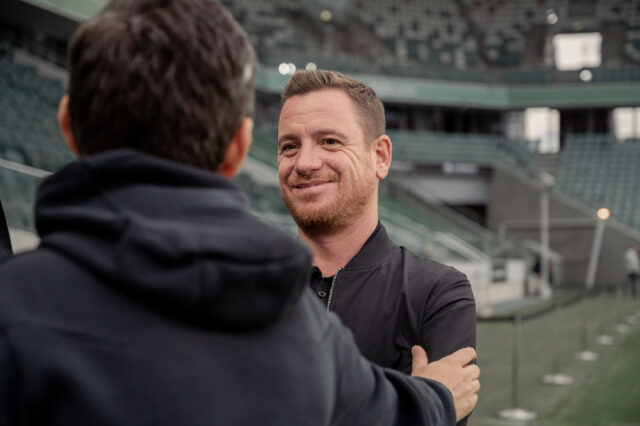
You have been working at Austria Wien in various areas (football school, youth development, academy, professional team) since 2016. What makes this club so special to you?
I have been connected to Austria Wien since childhood, I am a big fan and attended almost every game in my youth. When Ralf Muhr approached me in 2016, I didn't have to think twice. This club means a lot to me, it brings joy and frustration, and is very emotional overall. That's what makes Austria so special and such a big part of my life.
You have been Technical Director since May 2024 and have also been part of the Sports Management team since November. What is a typical day in this role at Austria Wien like?
My day usually starts with a telephone update with Michael Wagner and Manuel Takacs. Then I work through my schedule, most of which is already set the day before. This ranges from internal meetings and office work to observations on the pitch. As Technical Director, I am primarily the link between the youth teams, the academy, Special Violets, women's teams and Young Violets. The composition of the sports management team has now expanded my area of responsibility to include squad management for the professionals and, for example, drawing up contracts together with our lawyer Nina Silvester.
You learned sports management from the ground up and did not have an active career in professional football. Do you see any advantages or disadvantages in having learned the trade from the ground up?
Fundamentally, sports management is a very dynamic field. You have to constantly observe football and its developments and changes. For example, our players are currently on the radar of international scouts much earlier, even at youth level. We therefore try to create an environment for the players that convinces them and ultimately binds them to us contractually at an earlier stage. I have observed these developments first-hand in my roles over many years and learned to act with foresight, anticipate developments and adapt continuously. I spent the time I wasn't on the pitch as an active footballer in the office and learning by doing, as I lack experience as a player. We have other people here who bring this perspective to the table.
How does the cooperation within the sports management team work?
Michael Wagner is responsible for the sporting agenda of the professionals. He brings his perspective as a former professional and entrepreneur to the table, is a communicator and has strengths in leadership. Manuel Takacs is an absolute expert in top-level youth football, has worked as a coach and holds a UEFA Pro licence. I myself learned the trade from the ground up, have been with the club for almost ten years, know the people here and act as a link between the different areas of sport. We complement each other, all bring different experiences to the table, but pursue a common strategic direction with which we identify one hundred per cent. We have agreed that complete transparency is the key to success, so all issues are discussed within the team. Ultimately, it's about making informed decisions in the best interests of Austria Wien.
One of your goals as sporting directors is to pool the existing expertise within the club. You work with various sporting decision-makers on specific issues. What are these issues?
We are convinced that there is a lot of quality in the club in different areas, be it in development, scouting or data management. Our goal now is to better connect the areas and people, create synergies and thus ensure the best possible output. Decision-makers must be given a mandate to make decisions within their area of responsibility.
To give a few examples, we have Salih Dursun, a data analyst with a wealth of expertise at the club. In Max Uhlig, we have a coach who has been with the club for 10 years, who, together with Rene Glatzer, has been instrumental in developing our playing philosophy and who is very successful as a coach with our Young Violets in the 2nd division. In Raphael Thonhauser, we have a strategist at the club who has an overview of all issues and drives them forward in a significant way. We now want to involve these experts even more actively in the decision-making process.
One of your key tasks is strategic planning for player transfers. There is currently a lot going on behind the scenes in this area. Can you give us an insight into how you plan to increase permeability in the future?
The transition from youth to professional football is a very complex issue, with many parameters to consider. I often get the feeling that clubs are waiting for that one player who is outstanding at the age of 17. However, such talented players are very rare. We have set a goal within the club to increase permeability. The means to achieve this goal is our joint strategy. We will implement systems and procedures in the transition area, such as player roles, age groups and cycles, which provide a framework within which players can take their next steps. We will also staff the transition area so that we can keep a close eye on the development of our talented players.
How do you manage the balancing act between team success (promotion of the Young Violets, U16 and U18 championship titles) and individual player development?
In our training programme, we have placed greater emphasis on individual player development and moved the focus away from purely looking at results. For several years now, we have been proving that team success and individual player development go hand in hand and are not mutually exclusive. We have appointed individual coaches and developed position profiles. It took time and, above all, education and communication to establish this culture and mindset.
The best current example of this project is our Young Violets, who are shaking up the second division with a team made up of 90 per cent home-grown players and are currently the best second team. Development is not always linear, and we do not lose our nerve in phases where results are difficult. Last season, when the Young Violets were fighting for promotion and the U18s were fighting for the championship title, we did not change our approach and remained true to our principles.
The squads at the academy and the Young Violets have become significantly younger in recent years. When is the right time to promote a player to the next higher team?
It is important that a player is placed in an environment where he is slightly, but not overly, challenged. Being slightly challenged allows for steady development and quick adaptation to the higher level of performance, but being overly challenged leads to frustration and low self-efficacy for the player in the game. Parameters such as biological age, physical constitution and current performance level play an important role. Coaches are heavily involved here, as they work with the players on a daily basis. It's about making informed decisions in the best interests of the individual player. We won't always be right, but we want to give the player the best possible opportunity at the best possible time. We also pay close attention to this development plan in our youth teams.
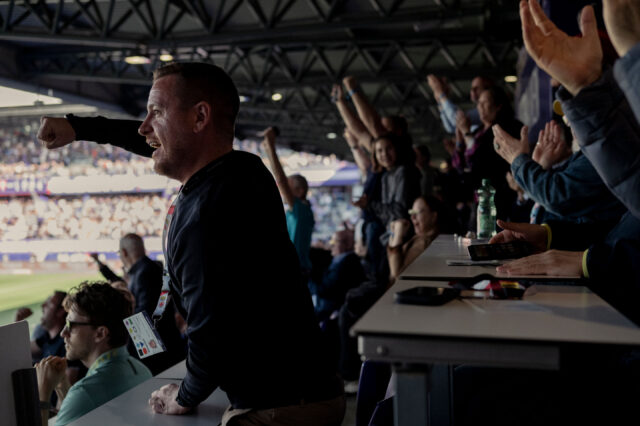
Robert Urbanek also lives for the games
How do you deal with this when communicating with the players?
Clarity creates certainty. We communicate clearly and honestly with the players. We explain to them why we are currently playing them in a particular team and what the medium and long-term plan is for them. Playing for the U18s as a Young Violets player should never be misinterpreted as a punishment, but rather as an opportunity to get playing time and prove themselves again for higher tasks. Just because a player may not be ready at the moment, the situation can change abruptly in a matter of weeks – that's how dynamic player development is. It is important that our key players get playing time, ideally in a team where they are slightly overwhelmed. There is a lot of communication here. However, we want to communicate even more intensively, transparently and at an earlier stage.
The environment, family and advisors also play an important role in player development. How does the cooperation work?
In most cases, cooperation with the environment is good; we have the same goal, but sometimes different ways of getting there. We can make decisions that are as objective as possible in the interests of the players. The immediate environment focuses on their respective protégés, which is completely understandable. What we do is present the environment with a clear plan and show that we care about the development of the respective player. We have shown in the recent past that we always make decisions in the best interests of our players and focus on their development.
In recent years, you have also defined player profiles that fit Austria Wien's playing style. How did you go about this?
It was important to us to broaden the player profiles and adapt them to the requirements of modern football. For us, this means that we want to promote players with different attributes in different positions. We want to continue to promote players with an Austria stamp who can find creative solutions with the ball in tight spaces. In addition, we want to train robust defensive players with a certain height, for example, and develop attackers with depth and pace. It was evident that in recent years we have produced players with different profiles who could be of interest to international clubs. Our approach is to identify and promote the strengths of our players.
The example of Filip Lukic also shows that you give players who are slow to develop the time they need to develop?
Absolutely. Filip Lukić has exceptional skills with the ball, which was already evident in the youth teams. His years at the academy weren't easy; he was overly challenged in his age group due to his physical condition, but we were patient with him and he never gave up, even during periods when he had less playing time. Now he's ready to be a key player for the Young Violets and has played some great games in the second division. His example shows that there's no template for becoming a professional footballer. Some players are ready to make the leap to the top at an early age, while others take a little longer. In addition to a plan, this requires patience, expertise and a shared commitment, in which the environment also plays an important role. Another big advantage for Filip was that Max Uhlig had already trained him in the U12 and U14 youth teams and was a great supporter of Filip.
Another point is continuity in the coaching teams in the development area. How important is this issue for you?
It was very important to us to keep those coaches at the academy and with the Young Violets who identify with our ideas and have a high level of expertise in player development. Of course, it can happen that coaches take the next step and are poached. Our goal is to train not only players but also coaches and staff.
How should squads be planned in the future?
They should be planned jointly and in line with our strategic orientation based on player roles. With the professional squad, we first want to see which home-grown players are ready for the next step. At the same time, we are keeping an eye on the market and looking at which benchmark players could be interesting in certain positions. It is important to anchor the awareness that we should first take a look at our own stable.
After the U17 World Cup in Qatar, several Austrian talents also expressed interest in transferring to Austria Wien. How did you experience this situation?
We want to follow the Austrian path, which naturally means that talents from other clubs are also of interest to us. As mentioned, we will first look within our own ranks. We want to be the go-to place for young Austrians who see the opportunity to become professionals with us. Our big goal for the future is to position ourselves as the club that offers the best platform here.
Our U19 team won the REWE Junior Cup 2026 in Göttingen for the sixth time. You were there yourself. How important is the tournament in Göttingen?
Participating in and winning Europe's biggest indoor tournament is always something special. By participating in the REWE Junior Cup, but also in the Al Abtal Cup and the UEFA Youth League, we want to expose our young players to this pressure in competitive situations for the first time. In doing so, we want to promote a winning mentality and prepare our players for media interest. That's why these tournaments are so important to us.